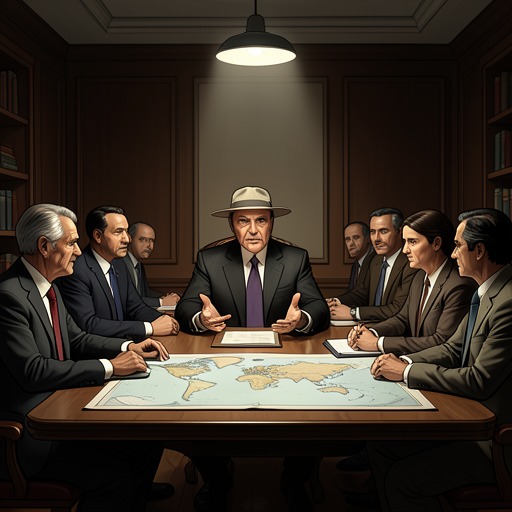
James F. Byrnes
American PrometheusJames F. Byrnes emerges as a consequential political architect of early atomic policy: he helped turn the bomb from a military project into an instrument of diplomacy, and pressed for its use and continued production while the United States sought to shape the postwar balance with the Soviet Union. In the final months of the war, his calculations collided with scientists’ warnings that atomic coercion could provoke an arms race, and with the possibility that Japan might seek peace before an invasion became necessary.
Political position and the bomb
Byrnes entered the decisive discussions of 1945 as a close political associate of President Harry S. Truman and his personal representative to the Interim Committee, the ad hoc body advising Secretary of War Henry L. Stimson on atomic policy. He was soon to become secretary of state. His position gave him influence at the intersection of military planning, presidential decision-making, and the emerging diplomatic contest with the Soviet Union.
That perspective was already visible on May 25, when Leo Szilard and two colleagues met Byrnes at his home in Spartanburg, South Carolina. Szilard warned that using the bomb against Japan risked turning the Soviet Union into an atomic power. Byrnes interrupted to invoke General Leslie Groves’s assertion that Russia had no uranium. Szilard replied that the Soviet Union had plenty. The exchange exposed a sharp divide: Szilard was concerned that the bomb could initiate a race ending in mutual destruction, while Byrnes regarded the immediate strategic and diplomatic consequences as central to the decision.
Byrnes then argued that bombing Japan might help persuade Russia to withdraw its troops from Eastern Europe after the war. Szilard was appalled by the idea that threatening Russia with the bomb could make it more manageable. His concern, he later wrote, was the danger of an American-Russian arms race that might destroy both countries; Hungary’s fate was not his immediate priority. He left the meeting deeply depressed. For Byrnes, the bomb’s possible effect on Soviet conduct was a reason to consider its use; for Szilard, that very calculation made the danger of using it more urgent.
The Interim Committee and competing strategies
On May 31, Byrnes attended the Interim Committee meeting at which Oppenheimer, Enrico Fermi, Arthur Compton, and Ernest Lawrence served as scientific consultants. The agenda did not formally ask whether the bomb should be used against Japan; that decision was treated as effectively settled and reserved to the White House. The discussion instead laid bare competing views about what atomic power would mean after the war.
Oppenheimer argued against prejudging the Soviet response and supported the possibility of sharing some knowledge of the project. General George C. Marshall likewise saw no reason to assume that Soviet scientists, if informed, would disclose the information to Japan, and raised the possibility of inviting Russian scientists to witness the test. Byrnes vigorously objected to that prospect. He feared that Stalin would then demand participation in the atomic project. The debate was not simply about whether information could remain secret: it concerned whether the United States should use its new advantage to invite cooperation or preserve a unilateral lead.
Byrnes pressed for rapid expansion of atomic production and research, while also calling for efforts to improve political relations with Russia. The committee minutes recorded general agreement with this position. Yet the two aims sat uneasily together. Oppenheimer and other scientists understood that a policy of racing to stay ahead could encourage the Soviet Union to pursue its own weapons, even as officials spoke of better relations. Byrnes’s approach made the bomb a diplomatic asset, but the pursuit of superiority threatened to intensify the rivalry that diplomacy was supposed to manage.
The committee’s discussion also turned to the impending use of the bomb. On the day before this meeting, Stimson had met with Truman and Byrnes; the available account describes the wider presidential calculation that the bomb offered a way to end the war before Soviet intervention. A clarification of surrender terms that might have enabled Japan to capitulate was opposed by Byrnes on domestic political grounds. Without such a change, the bomb appeared to be the means of ending the war before the Soviet Union entered it. The choice thus had consequences beyond defeating Japan: it could also affect the postwar position of the United States in relation to Russia.
Japan, surrender, and Soviet timing
In July, Truman and his advisers received indications that Japan was looking for peace. The first invasion of the Japanese home islands was not scheduled before November 1, and nearly all of the president’s advisers expected the war to end before then. Truman believed a Soviet declaration of war might prove decisive; in a July 18 diary entry, he referred to an intercepted message from the Japanese emperor asking about peace. Byrnes, however, opposed clarifying the surrender terms to allow Japan to retain its emperor, in part because of domestic political considerations.
The timing mattered. Byrnes later explained that it was constantly in his mind that the war should end before the Russians entered it. On August 3, an aide’s diary recorded that Truman, Byrnes, and William D. Leahy believed Japan was seeking peace, while Truman feared that it might pursue peace through Russia. The atomic bomb offered an alternative to both a change in the surrender terms and waiting for Soviet intervention. In this context, the weapon was not only a means of bringing the Pacific War to an end; it was also part of a contest over who would shape the settlement that followed.
Oppenheimer, isolated at Los Alamos, did not know about the intelligence intercepts or the debate among Washington officials over surrender terms. He therefore could not know that the military use of the bombs was being considered alongside other possible routes to ending the war, or that preventing Soviet intervention was part of the administration’s calculation. After the war, he came to believe that he had been misled by government officials. That later realization helps mark the distance between the scientists’ understanding of the project and the political calculations surrounding it, without establishing that Byrnes personally conveyed false information to Oppenheimer.
Political and business connections
Byrnes’s influence extended beyond the 1945 meetings. His relationship with Bernard Baruch was close, and accounts of their connection also point to business ties. Baruch was a friend and business associate of William Boyce Thompson, founder of Newmont Mining Corporation. Fred Searls, who headed Newmont and had served as Byrnes’s wartime assistant, wanted Byrnes’s help protecting the company’s tax status. The documented links place Byrnes within a network where government service, political relationships, and business interests overlapped; they do not, by themselves, establish what action Byrnes took or what outcome followed.
Taken together, the record presents Byrnes as a forceful advocate of American strategic advantage at a moment when atomic policy was still being defined. He argued for maintaining and expanding the country’s atomic lead, resisted sharing the project with Soviet representatives, and viewed the bomb’s diplomatic leverage in relation to the timing of Soviet entry into the war. Those choices illuminate the political logic surrounding the bomb’s use and the postwar competition it helped inaugurate: cooperation remained a stated aim, but the effort to secure advantage shaped what cooperation could mean.